
NAPLEX mistake log: what to record and how to review
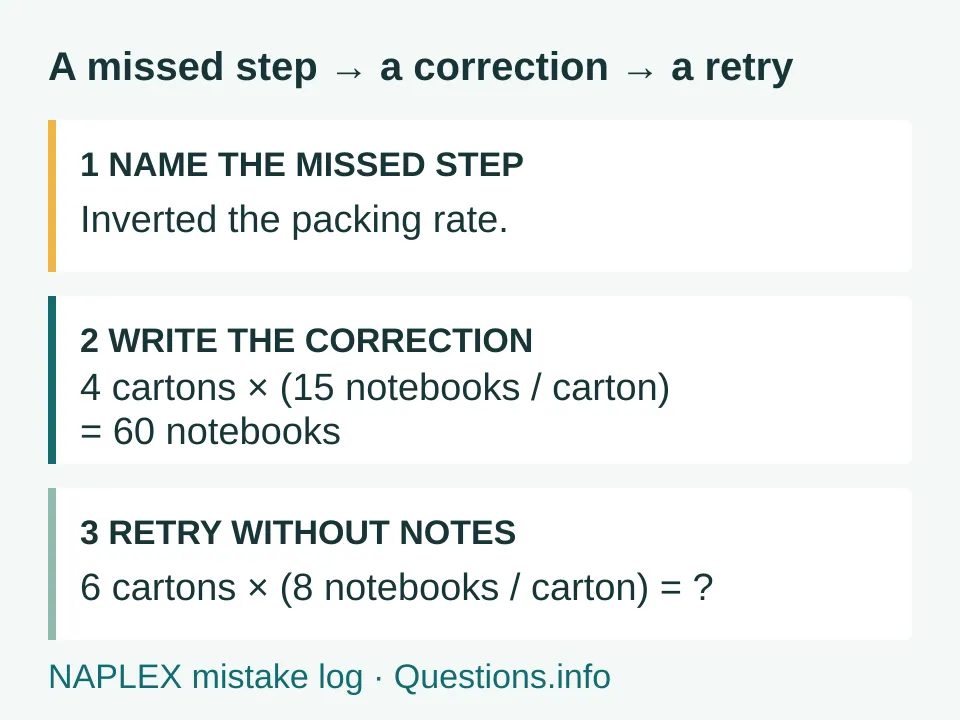
A NAPLEX mistake log turns a missed practice answer into a specific correction and a task to try again. Record the question reference, the step you missed, the corrected reasoning and a review date. When you return, explain the correction without notes and apply it to a different question; recognizing the old answer alone doesn't show that you can use the method.
What should a NAPLEX mistake log include?
Keep enough detail to reconstruct your reasoning, without copying the question stem or answer choices. A question ID, page number or link lets you return to the original explanation.
Use these nine fields in a notebook, spreadsheet or printable sheet:
- Date: when you attempted the question.
- Topic: the concept you need to revisit.
- Question reference: an ID, page or link.
- Missed step: what you didn't know, misread or set up incorrectly.
- Source to revisit: the explanation or reference section that supports the correction.
- Corrected reasoning: your explanation in your own words, including units when relevant.
- Next study action: one task you can actually complete.
- Next review date: a time to test the correction again.
- Review result: what you could explain and solve without notes.
The useful entry is “I inverted the conversion factor,” rather than “bad at calculations.” The first tells you what to practice.
Match the next task to the missed step
Before adding more questions, identify what went wrong. These labels are a practical way to choose a next action, not a scoring system.
- Missing knowledge: find the relevant source section, write the rule and test yourself on it.
- Missed instruction or clue: identify the words you overlooked, then practice stating what a new question asks before solving it.
- Setup or unit error: write the target unit first and rebuild the calculation with units on every factor.
- Arithmetic or transcription error: keep the valid setup, redo the calculation and compare your written values with the prompt.
- Uncertain reasoning despite a correct answer: explain why your choice fits and why the closest alternative doesn't. If you can't, add the gap to your review list.
If several errors occurred, start with the earliest one that changed the answer. A correct arithmetic calculation won't repair an inverted conversion factor.
A filled-in entry: fix a conversion, then change the numbers
Say a practice exercise asks how many notebooks are in four cartons, with 15 notebooks per carton. You divide 4 by 15 instead of multiplying. This nonclinical example isolates the unit step so you can see what a useful log entry looks like.
- Date: November 23, 2026.
- Topic: unit cancellation.
- Question reference: personal exercise, conversion A.
- Missed step: I divided by the packing rate without checking which unit should cancel.
- Source to revisit: the exercise's stated rate: 15 notebooks per carton.
- Corrected reasoning: 4 cartons × (15 notebooks / 1 carton) = 60 notebooks. Cartons cancel, leaving the requested unit, notebooks.
- Next study action: write and solve a new packing conversion with units on every factor.
- Next review date: November 25, 2026.
- Review result: leave blank until the retry.
On November 25, cover the correction. Try six cartons with eight notebooks per carton. Before calculating, state the target unit and write the factor that cancels cartons:
6 cartons × (8 notebooks / 1 carton) = 48 notebooks.
Then record what happened: “I chose notebooks/carton without notes and explained why cartons cancel.” If you inverted the factor again, keep the entry active and practice another setup. Don't replace the missed step with “be more careful.”
The dates are an example review interval, not a prescribed NAPLEX schedule. Choose a return date that fits your available study sessions.
How do you review a mistake log without just rereading it?
Turn the correction into a question before looking at your notes. For the conversion above, ask: “Which unit must cancel, and where does it belong in the factor?” Write your answer, solve a fresh problem and then compare your reasoning with the source.
This uses retrieval practice: trying to recall information before checking it. In a 2008 study by Karpicke and Roediger, repeated testing improved delayed recall of foreign-language vocabulary after initial learning. That study supports recall-based review; it doesn't establish a NAPLEX score benefit or validate a particular mistake-log template.
At your weekly review, look for repeated missed steps across entries. If three different questions show the same unit error, choose one focused unit-cancellation task before another large mixed set. Keep the individual question references so you can check whether the correction transfers across them.
For room to fit these retries around work, use the NAPLEX study schedule while working full time.
Use a sheet you can print or type into
Questions.info's free NAPLEX mistake-log worksheet has these nine prompts, US Letter and A4 PDFs, and an editable, printable HTML version. No signup is needed. If you type into the HTML worksheet, print your completed entry before closing it: entries stay in the tab and aren't sent or saved by the worksheet.
Keep your next study read close
Opt in by email, or follow new articles in your feed reader. Email notifications are not automated yet.