
NAPLEX study schedule while working full time
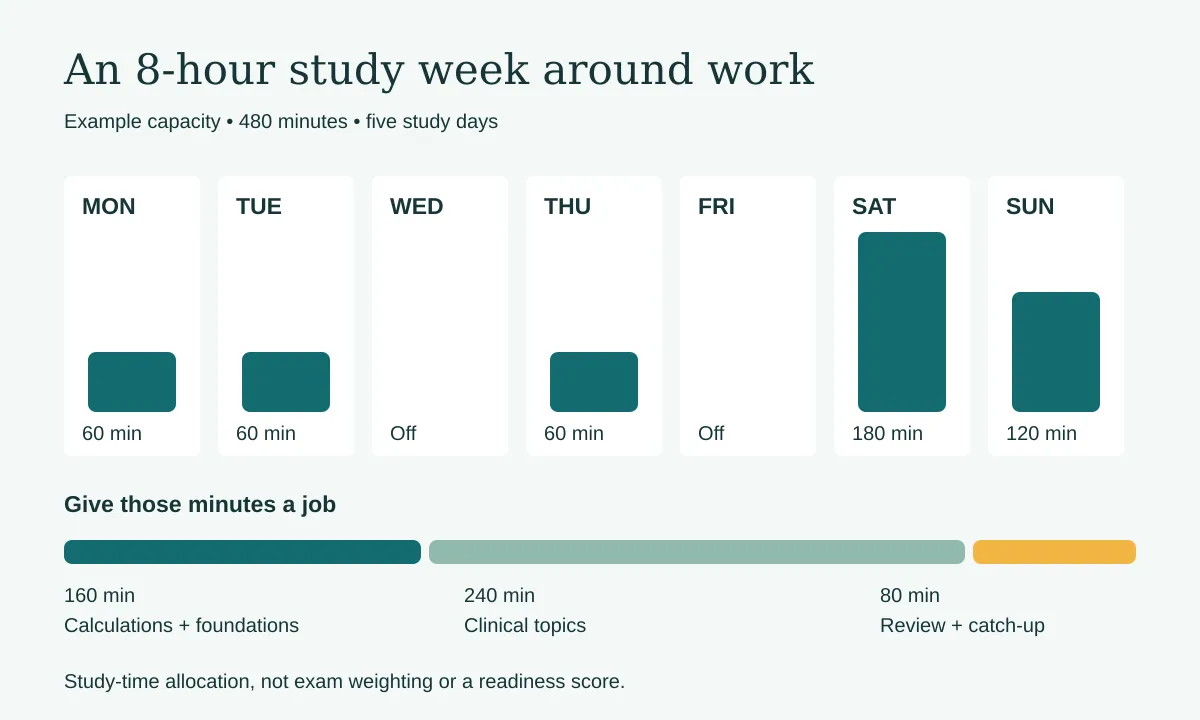
Build a NAPLEX study schedule while working full time by counting the minutes you can reliably protect each week, then assigning them to content, practice and review. Leave room for missed sessions and adjust the plan using what your practice reveals. The eight-hour week below is a scheduling example, not a recommended preparation total or a prediction that you'll pass.
Build a NAPLEX study schedule while working full time
Start with your actual shifts, commute, sleep and other commitments. A study block belongs in the calendar only if you can use it without borrowing time from something you still need to do.
- Mark work and unavailable time first, including recovery after demanding shifts.
- Add study blocks to the remaining time. Use different durations on workdays and days off.
- Count focused study minutes, excluding breaks.
- Reserve part of that capacity for reviewing errors and catching up.
- Revisit the calendar after one week of actual use.
If you haven't scheduled the exam, build a rolling four-week plan. You can learn how much work fits before committing to a longer calendar.
An eight-hour weekly schedule you can adapt
Say a graduate pharmacist works full time and can protect three one-hour workday sessions plus five hours across the weekend. This is a fictional planning example. Shift workers can move the blocks to different days while keeping the same weekly total.
| Day | Focused minutes | Task |
|---|---|---|
| Monday | 60 | Calculations and foundational concepts |
| Tuesday | 60 | One clinical topic: recall, then check gaps |
| Wednesday | 0 | No planned study |
| Thursday | 60 | Practice questions on that clinical topic; review explanations |
| Friday | 0 | No planned study |
| Saturday | 180 | 100 minutes of foundations and 80 of clinical work, in separate blocks |
| Sunday | 120 | 40 minutes of clinical work and 80 for error review or catch-up |
| Total | 480 | 8 focused hours, with breaks scheduled separately |
That assigns 160 minutes to calculations and foundations, 240 to clinical topics, and 80 to review and catch-up. These are personal time allocations, not official exam weights. Professional practice and management topics still need places in later weeks; a weekly focus isn't permission to omit other content.
Use the review block first for unresolved errors. If no session was missed and the error review is complete, use the remaining time to revisit an older topic without notes.
Choose topics from the current NABP outline
Use your study resource's contents alongside the NABP NAPLEX Content Outline, effective for exams beginning May 1, 2025. NABP organizes the outline into five major domains and provides approximate exam weights. It is the coverage checklist; your recent practice helps determine where you need extra time.
Make a simple tracker with three columns:
- Content area: the outline area and the corresponding chapter or lesson in your resource.
- Evidence of a gap: a missed question, a correct guess, a calculation error or an explanation you couldn't give.
- Next task: a specific action you can finish in one block.
“Review cardiovascular” is too broad for a one-hour session. “Answer a short set on one cardiovascular topic, explain each choice, and check the missed concepts against the referenced material” gives the block a finish line.
Keep untaught or unreviewed areas visible in the tracker. A weak-topic plan should change the amount of attention each area gets, not erase the rest of the outline.
Give each study block an observable result
A completed chapter tells you what you read. A closed-book explanation tells you what you can retrieve.
For a 60-minute block, try this starting structure:
- 10 minutes: recall the previous session's concepts or solve a few previously missed problems without notes.
- 25 minutes: study one defined gap or answer a manageable question set.
- 20 minutes: explain the reasoning, check sources and record errors.
- 5 minutes: write the exact next task.
Change that split when needed. A difficult explanation may deserve the whole session. Set question counts only after you know how long answering and reviewing take; rushing through explanations to reach a daily number defeats the purpose of practice.
For each error, record the cause and a follow-up task. Distinguish a knowledge gap from a unit conversion mistake, a missed detail in the stem or time pressure. They need different fixes.
What should you do after missing a session?
Move one task into the catch-up block before adding more hours. If Thursday's 60-minute session is missed in this example, Sunday's 80-minute reserve can absorb it, leaving 20 minutes for error review.
If you miss both Monday and Thursday, the lost 120 minutes exceed the reserve by 40. Move an unfinished task into next week and reduce next week's new work accordingly. Don't keep the old task list and pretend that the time is still available.
At the end of the week, compare planned and completed minutes. Repeatedly missing the same block suggests a calendar problem: shorten it, move it or remove it. Repeated errors on the same concept suggest a study-task problem: change how you practice that concept.
How many weeks should you study for the NAPLEX?
The number of weeks depends on both your available time and the gaps you need to close. A calendar alone cannot establish readiness. Eight hours per week over eight weeks provides 64 hours; over 12 weeks it provides 96. Those totals describe capacity, not sufficient preparation.
After your first week, estimate the remaining work using your actual pace, including explanation review. If it won't fit before your scheduled exam, decide which constraint can change: protected study time, the approach to inefficient tasks or the exam date, subject to applicable scheduling rules. Ask a faculty adviser or preceptor for help interpreting persistent knowledge gaps rather than relying on an unsupported universal hour target.
Include longer timed practice in later planning. NABP describes the NAPLEX as a six-hour, 225-question exam. Short workday blocks are useful for learning, but don't tell you how you'll manage a prolonged testing session.
Turn your available minutes into a weekly plan
Questions.info's free NAPLEX study planner lets you enter daily minutes, choose topic priorities, and edit and print weekly allocations without an account. Use it to organize the schedule above or your own shift pattern; it allocates time and does not assess exam readiness.
Keep your next study read close
Opt in by email, or follow new articles in your feed reader. Email notifications are not automated yet.